Last year, I discovered a new sewing obsession: making moccasins! With our outdoor lifestyle in Perth and a rough concrete patio, I had the perfect excuse to try making them for my toddler. It was a project I’d wanted to do for years, though I found it oddly intimidating at first. To my delight, the process turned out to be simple, straightforward, and incredibly satisfying. I love seeing my daughter, Birdie, potter around in the little mocs I made her. In these photos, she’s also wearing some Mini Virginia leggings I made, which are a size 2/3 and still baggy on her as she’s not quite two yet.
Regarding the leather, I sourced all of it from Leather Direct in Osborne Park. Concerned about regular cowhide being too stiff for my small child, I experimented with thinner lambskin for the pale pink and black pair and goatskin for the copper pair. The lambskin worked wonderfully—soft, supple, and a dream to sew—though it does show wear quickly, which I didn’t mind for garden and school run use. As Birdie approaches two, I’ll switch to a thicker cowhide. The goatskin, however, was very stiff, similar to vinyl, and I do not recommend it. I strongly advise using real leather for baby moccasins, as synthetic materials are uncomfortable and non-breathable for little feet. For the pale pink pair, I used the Baby Moccasin pattern by Simply Small Wonders, available on Etsy and her website. It’s a great pattern with accurate sizing and good explanations. My only note is that the sole piece is foot-shaped rather than oval, which sometimes led us to put the mocs on the wrong feet, requiring constant swapping. Sadly, I never got photos of Birdie wearing that very first pale pink pair—she wore them completely out before growing out of them, and I’ll treasure them like a little relic. A side note on the photos: the cropping is unfortunate, showing little of her cute face, but photographing a moving toddler is always a take-what-you-can-get situation!LIL PAPOOSE MOCCASIN PATTERN
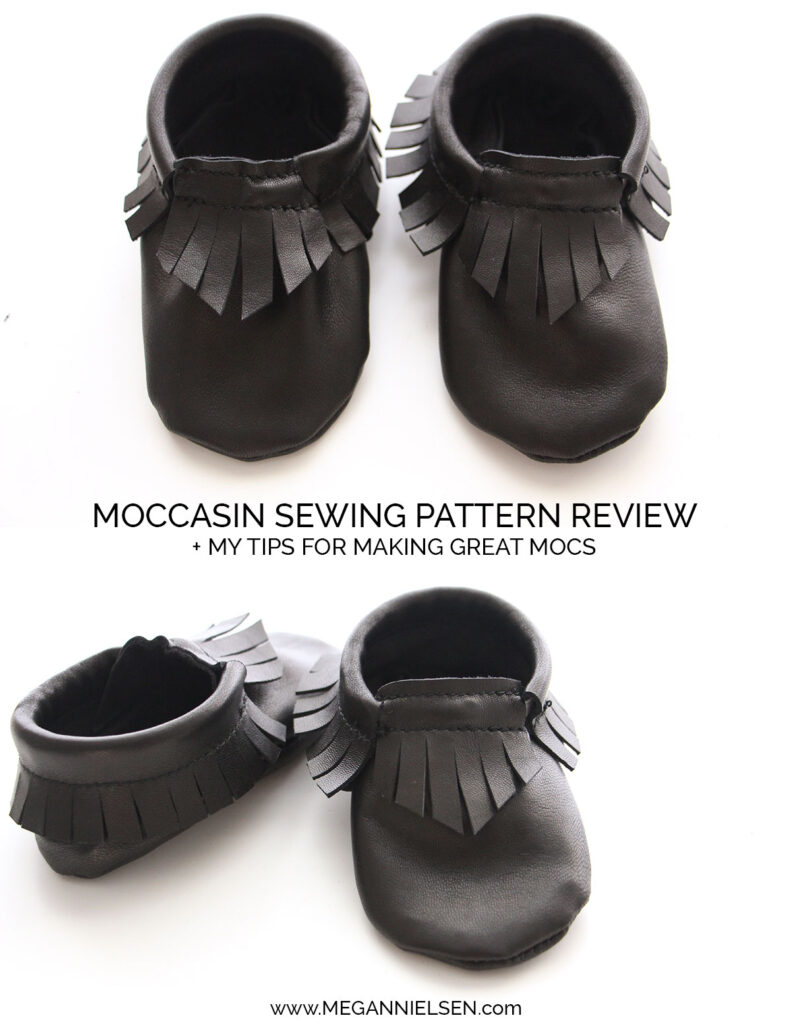
For the black pair and another copper pair, I used the Lil Papoose moccasin pattern from Peekaboo Pattern shop, a recommendation by Jill. I really like the fit of these mocs. The pattern shape is more oval, so you don’t need to worry about which foot is which, and I really like that. The thing I don’t like is the fringe style of this pattern. It wasn’t a big deal to alter; I just made the front fringe larger and then removed that same amount from the back/side fringe to compensate. This pattern, with that small modification to the fringe pattern pieces, is my go-to pattern. I highly recommend it. For my next pair, I’d like to try some without fringe or perhaps add a bow. I also purchased the Baby Bow Mary Janes pattern but haven’t had a chance to try it out yet. Regarding other designs, I finally just wrote ‘L’ and ‘R’ underneath them, but that looked a bit messy. I don’t think it’s really worth having a moulded sole shape for a baby/toddler as their feet are like little oblong boats anyway. That being said, it’s a great pattern without any modifications and gives that classic moccasin look that we all seem to like these days. I would definitely recommend it! MY TIPS FOR MAKING GREAT MOCCASINS Use your best sharpest scissors or a rotary cutter. Leather can be a pain to cut if your scissors aren’t sharp, so use the good ones. Leather needle. Seriously, do not forget this; you will cry if you leave a ballpoint needle in your machine. Topstitch thread. I didn’t see any mention in either pattern about which thread to use, but now I know from experience you absolutely need to use topstitch thread or similar. I used regular thread in the copper pair I made, and I had to resew the toe seam endlessly because the thread couldn’t handle the beating. Since then, I only use topstitch thread, and I’ve never had an issue. Walking foot. Yes, you can sew these without a walking foot, but now is a very good excuse to buy one if you don’t already have one. It makes sewing leather infinitely easier if you use a walking foot. Loop turner. This is a bit of a strange one, but when it came to threading the elastic through, I found the least painful method was to use my loop turner. That lovely skinny metal shaft slipped through the casing easily, and the hook on the end helped pull the elastic through. Trace your pattern pieces onto the leather before cutting. This prevents any slippage issues, helps you make the most of your leather with efficient layout, and means no worrying about pins etc. I found a pencil worked well for light leathers and a black pen for darker leathers. Make sure you practice first! Practicing first will ensure that your machine tensions are correct and help you figure out the best stitch length. I found that a longer stitch length was best. I usually favour a very short stitch length, but for leather, I found that had the effect of cutting through the leather rather than periodically puncturing it.Don’t just jump in; get the hang of sewing with leather scraps first.
I avoid using clips for leather sewing, as I find them irritating and bulky. Instead, I prefer to pin along the seamline in a few strategic places. For moccasins, I pin at the heel and then at the sides. That’s it. Leather can easily stretch and pull in the wrong direction during sewing, especially around the heel. For this pattern piece, I sew from the centre to the side seams rather than from one side around to the other. This adds a tiny bit of time but results in a perfectly even sew. I dislike asymmetry. When cutting the front fringe, I leave it uncut until just before the end. Then, I cut up the centre, followed by the triangle shape, and finally the rest of the fringe. I also cut the heel fringe before inserting the elastic. For inserting elastic, measure and mark your elastic length, but DO NOT CUT. I mean it—do not cut. As mentioned, I use a loop turner to pull the elastic through. Once at the other side, find the mark again and sew along the line. However, I don’t sew the elastic part, as I find it fiddly and frustrating. Instead, I tie a knot and pull it so that it sits hidden in the casing at the front of the shoe. This method makes it easy to find the knot later and adjust the elastic tightness if needed.